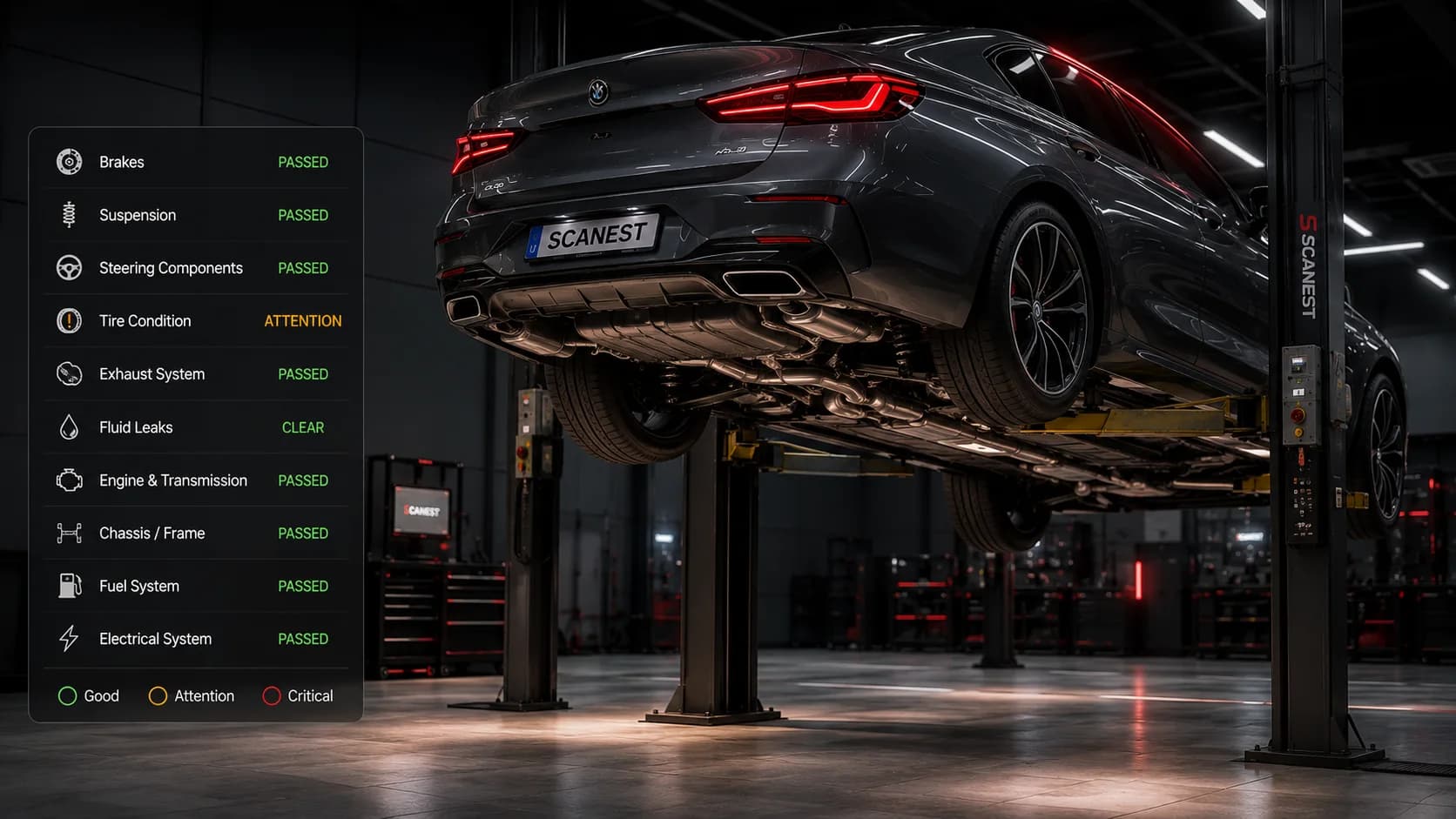
The underside of a vehicle contains the chassis, suspension, steering, exhaust, fuel and brake lines, structural rails and—in an electric vehicle—the battery enclosure. A 3D underbody vehicle scanner captures this hard-to-see area in seconds, creating a consistent digital record without first placing the vehicle on a lift.
These drive-over systems began largely in security screening and are now increasingly relevant to dealerships, inspection centers, fleets, auctions and used-car certification. This guide explains how they work, where 3D and AI claims differ, and which manufacturers serve security versus automotive inspection.
What is a 3D underbody vehicle scanner?
A 3D underbody vehicle scanner—also called an Under Vehicle Surveillance System (UVSS) or Under Vehicle Inspection System (UVIS)—is a fixed, surface-mounted or portable platform installed in a vehicle lane. Cameras and controlled lighting capture the undercarriage while the vehicle drives across it.
Not every UVSS produces a true geometric 3D model. Some systems create a high-resolution panoramic image; others use dual-view, stereo or depth-processing technology. Buyers should ask manufacturers to define exactly what “3D” means in the proposed system and request representative output.
How drive-over undercarriage scanning works
- Vehicle detection: lane sensors trigger the system as a vehicle approaches.
- High-speed capture: industrial cameras record sequential images while the vehicle remains in motion.
- Controlled illumination: high-output lighting reduces shadows around axles, covers and crossmembers.
- Image reconstruction: software stitches the captures into one searchable underbody view; selected platforms also calculate depth or offer multiple viewing angles.
- Identification: optional number-plate, vehicle-classification and driver cameras link the scan to a specific vehicle.
- Analysis: software compares previous visits or uses AI to flag foreign objects, leaks, corrosion, damage or missing components, depending on its training and intended market.
Benefits and limitations
A well-designed scanner improves throughput because each vehicle follows the same capture process. It can preserve a high-resolution baseline, support repeat-visit comparisons and give a technician a fast way to zoom into areas that deserve physical inspection.
- Seconds-long drive-over capture without first occupying a lift
- Consistent lighting and viewing geometry across vehicles
- Permanent visual records for reports, audits and comparisons
- AI-assisted anomaly detection where supported and validated
- Integration with plate recognition, access control or inspection software
- Higher intake throughput in busy lanes
However, an optical scanner cannot test component play, confirm material thickness, assess concealed rail damage or replace OEM-based structural measurement. Dirt, water, undercoating, vehicle speed and occlusion can also affect results. Treat automated findings as inspection evidence—not a final safety diagnosis.
Security UVSS versus automotive inspection scanners
| Requirement | Security-focused UVSS | Automotive-focused scanner |
|---|---|---|
| Primary objective | Foreign objects, modifications and identity anomalies | Leaks, corrosion, missing parts and visible damage |
| Typical customer | Borders, airports, defense and critical infrastructure | Dealers, inspection centers, fleets and auctions |
| Common integrations | LPR/ANPR, access control, facial or vehicle classification | DMS, service workflow, condition reports and customer communication |
| Historical comparison | Digital fingerprint and threat-change detection | Condition change and repeat-service comparison |
| AI training target | Threat and foreign-object detection | Mechanical and condition anomalies |
Security X-ray portals are a separate category again. They can image concealed cargo or vehicle contents using ionizing radiation and operate under different safety, regulatory and infrastructure requirements. They should not be compared directly with optical undercarriage cameras.
Leading underbody scanner manufacturers
Rapiscan Systems — Gatekeeper IVUS
Best suited for: border crossings, airports, government facilities and critical infrastructure.
Rapiscan’s Gatekeeper Intelligent Vehicle Undercarriage Scanner produces consistent high-resolution imagery and supports historical matching, foreign-object detection and integration with Gatekeeper license-plate and vehicle-classification products. Current Rapiscan materials offer single-view, dual-view and relocatable configurations.
Official Gatekeeper IVUS product page
UVeye — Helios
Best suited for: dealerships, repair shops, auctions and fleet inspection.
UVeye’s Helios is positioned specifically for automotive underbody condition assessment. It captures high-resolution imagery and uses AI to flag issues such as leaks, rust and damaged, missing or modified components, with results designed for service and condition-report workflows.
Official UVeye Helios overview
SecurOS UVSS
Best suited for: enterprise security, industrial sites, smart infrastructure and government facilities.
SecurOS UVSS combines under-vehicle imaging with recognition and security-management tools. Buyers should confirm the available 3D inspection, anomaly-detection and integration features for the exact configuration quoted in their region.
Vehant Technologies / UVSS.ai
Best suited for: airports, logistics, corporate security and government checkpoints.
The NuvoScan and DepScan families include optical inspection options with automated analysis, number-plate integration and, on selected systems, stereo or 3D capabilities. Verify whether the quoted product is marketed and supported directly by Vehant or a regional channel.
Leidos VACIS
Best suited for: customs, ports, border security and high-throughput cargo inspection.
Leidos VACIS products are non-intrusive X-ray inspection systems rather than conventional optical UVSS platforms. They are relevant when the objective is detecting concealed threats or contraband throughout a vehicle or cargo load, not routine automotive condition assessment.
Official Leidos VACIS product page
Gatekeeper is now part of Rapiscan Systems
Gatekeeper Intelligent Security should no longer be presented as an independent current manufacturer. OSI Systems acquired Gatekeeper in February 2022 and integrated its optical vehicle-inspection technology with the Rapiscan cargo and vehicle screening portfolio.
The Gatekeeper name continues as a Rapiscan product family, including Gatekeeper IVUS for undercarriage inspection, ILPA for license-plate analytics and IVCA for vehicle classification. In other words, “Gatekeeper” remains a valid product name, while Rapiscan Systems is the correct current company context.
Official Rapiscan AS&E company history · Current Rapiscan optical-inspection portfolio
Underbody scanner buying checklist
- Use case: mechanical condition, security threats, access control or cargo screening
- Capture type: panoramic 2D, dual-view, stereo depth or measurable 3D output
- Vehicle limits: axle load, width, ground clearance and supported travel speed
- Detection evidence: validation data for the exact anomalies important to your operation
- Installation: surface, flush-mount, relocatable or portable design and required civil work
- Environment: ingress protection, drainage, operating temperature and cleaning requirements
- Identification: LPR/ANPR, VIN workflow, vehicle classification and driver imagery
- Integration: documented APIs, report exports, access control, DMS or inspection software
- Data governance: retention, encryption, regional hosting and access permissions
- Support: calibration, local maintenance, spare parts, software updates and response time
The future of automated underbody inspection
Underbody scanning is moving from image capture toward structured condition intelligence. The most useful advances will be reliable change detection, clearer confidence scores, model-specific component recognition and direct connection to vehicle history and inspection reports.
For automotive facilities, the strongest system will not simply produce the most dramatic image. It will capture consistently, surface relevant findings, preserve the original evidence and fit naturally into the technician’s verification and reporting process.
Frequently asked questions
3D underbody scanner FAQ.
What is a 3D underbody vehicle scanner?
A 3D underbody scanner is a drive-over imaging system that captures a vehicle’s undercarriage as it passes over a camera and lighting platform. Depending on the product, software can build depth information, compare repeat visits and use computer vision to flag anomalies.
What is the difference between UVSS and UVIS?
UVSS means Under Vehicle Surveillance System and UVIS means Under Vehicle Inspection System. The terms often describe similar optical drive-over systems, although product capabilities range from operator-reviewed panoramic images to AI-assisted 3D analysis and automatic change detection.
Did Rapiscan Systems acquire Gatekeeper Security?
Rapiscan Systems’ parent company, OSI Systems, acquired Gatekeeper Intelligent Security in February 2022. Current Rapiscan optical-inspection products retain the Gatekeeper product name, including Gatekeeper IVUS.
Can an underbody scanner replace a vehicle lift inspection?
No. It can create a fast, consistent visual record and flag visible anomalies, but it cannot confirm every mechanical or structural condition. Safety-critical findings still require inspection by a qualified technician using the appropriate lift, measurement or test equipment.
Which underbody scanner is best for an automotive inspection center?
Automotive facilities should prioritize models trained to detect leaks, corrosion and missing or damaged components, plus clear report exports and workflow integration. Security facilities generally prioritize foreign-object detection, identity matching, ruggedness and access-control integration.